Article

Just-in-Time Adaptive Interventions
Trigger interventions from real-time physiological data
Just-In-Time Adaptive Interventions (JITAI) on Labfront stream live physiological data from Garmin devices and fire the task or notification the instant your trigger conditions are met. No manual monitoring, no lag.
Schedule a consultation
Learn how it works
JITAI requires customization. Every implementation is scoped directly with your research team.
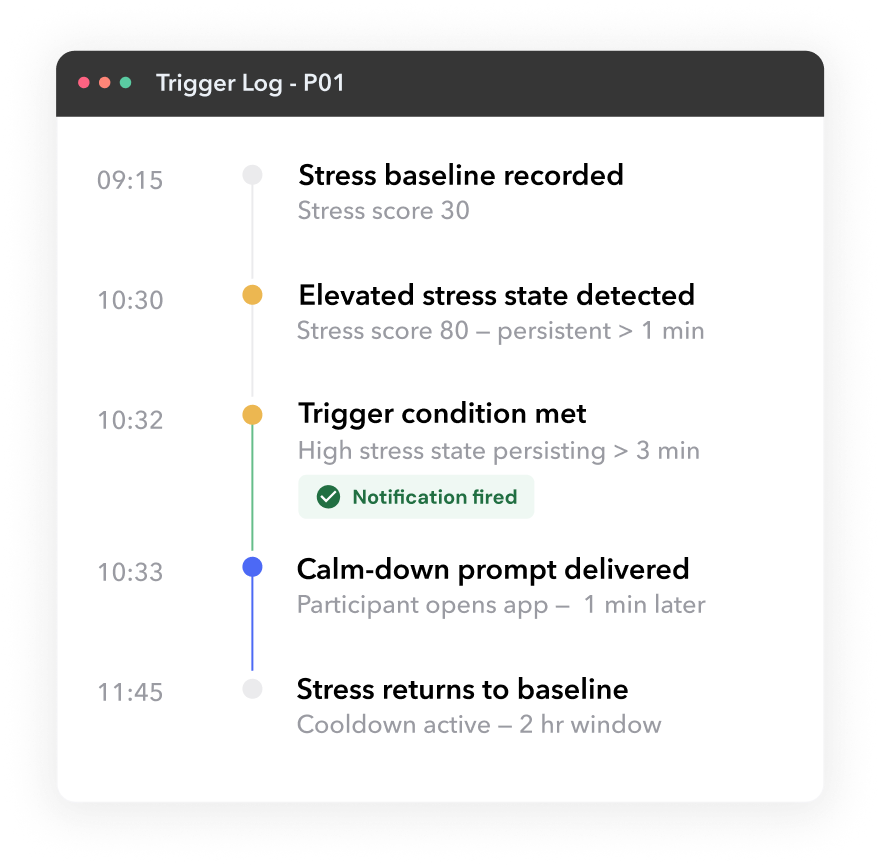

Collect. Detect. Intervene.
1
Define your trigger conditions
Specify the physiological threshold or behavioral signal that indicates your target state — stress, heart rate, step count, sleep quality, or combinations. Set duration requirements and cooldown periods to control intervention frequency per participant.
.svg)
2
Select “Actigraphy Data Collection” and other features
In addition to actigraphy data, you can choose from a wide selection of physiological data including activity, sleep, heart rate, and heart rate interval.
Customize your sampling rate for higher-resolution data. Every minute, every second. It’s your choice.
.svg)
3
Invite participants to join your project and collect data
Add participants to your project by distributing a unique invite code generated in Labfront to each one.
.svg)


.svg)

“Now, more than ever, we need tools like Labfront that can help researchers take their research and data collection virtual.”

.webp)
“The Labfront team was extremely responsive to our requests and made every effort to accommodate our unique needs.”


"Labfront's analysts understood our needs as researchers and saved us weeks of work when they prepared our datasets for analysis."


“The physiological data really helped provide deeper insights. We recommend Labfront and will definitely be using it again!”

.svg)
How it works
Collect. Detect. Intervene.
Set your trigger conditions once. Labfront monitors incoming wearable data continuously and executes your JITAI protocol in real time, across every participant in your study.
1
Define your trigger conditions
Specify the physiological threshold that indicates your target state. Use any biomarker Labfront collects — HRV, step count, sleep stage, or combinations. Set duration requirements and cooldown periods to control intervention frequency per participant.
2
Connect your intervention
Attach the content that fires when conditions are met: a survey prompt, push notification, breathing exercise, or custom message. Different triggers can route to different interventions. You control exactly what participants receive and when they're eligible again.
3
Collect state-aware data
Every intervention event is logged with the triggering signal, timestamp, and participant response. Your dataset includes not just what participants did, but what their physiology was doing when the intervention arrived — the ground truth for real-world efficacy research.
Research domains
Built for research where timing is the hypothesis.
These aren't hypothetical use cases. They come from funded research teams designing protocols that require state-contingent interventions, not fixed-schedule prompts.
Stress and anxiety interventions
Trigger mindfulness prompts or guided breathing when physiological indicators of acute stress are detected — not at 2pm because your protocol says so. Pairs HRV-based stress detection with immediate intervention delivery.
Craving and relapse prevention
Deliver coping strategy prompts when physiological arousal patterns associated with craving are active. A custom algorithm evaluates continuous BBI and actigraphy streams to interrupt the behavioral sequence before it completes, not respond to it after.
Physical activity and rehabilitation
Deliver a rest prompt when exertion metrics exceed a safe range, or trigger an encouragement message when activity falls below a daily target. For rehabilitation and exercise adherence studies, JITAI closes the loop between real-world physiology and protocol response.
Sleep hygiene and circadian research
Trigger wind-down prompts when evening physiological data suggests a participant is at risk of delayed sleep onset. Measure sleep architecture outcomes against intervention timing. Real-world variability becomes a study input, not noise to control for.
Grant development support
We help you write JITAI into your grant.
JITAI is currently in development. If you're designing a study that needs state-contingent interventions, reach out now. We work directly with your team to scope the technical implementation, describe platform capabilities for grant reviewers, and confirm feasibility before your submission deadline.
Study section reviewers want concrete technical commitments: how triggers fire, what data supports them, how thresholds will be calibrated per participant, and how your team will validate trigger accuracy. We draft the data collection and infrastructure sections of your R01, R21, or U01 in language that satisfies study section expectations. NIH-funded JITAI projects grew from 2 in 2016 to 36 in 2024. The most active funders are NIDA, NIDDK, and NIMH.
01 — Technical feasibility statement
A written description of JITAI capabilities on Labfront, suitable for your data collection plan or technology section. Describes the streaming architecture, trigger logic, and real-time data pipeline in language grant reviewers expect.
02 — Trigger logic documentation
We work through your trigger conditions and document the full data flow from wearable signal to intervention delivery. This gives your IRB and study section reviewers a complete picture of the algorithm.
03 — Confirmed device compatibility
Verify which Labfront-compatible devices and biomarkers align with your JITAI design before you commit them to your protocol. Avoids the grant submission problem of specifying hardware that doesn't support your trigger signal.
01 — Technical feasibility statement
A written description of JITAI capabilities on Labfront, suitable for your data collection plan or technology section. Describes the streaming architecture, trigger logic, and real-time data pipeline in language grant reviewers expect.
02 — Trigger logic documentation
We work through your trigger conditions and document the full data flow from wearable signal to intervention delivery. This gives your IRB and study section reviewers a complete picture of the algorithm.
03 — Confirmed device compatibility
Verify which Labfront-compatible devices and biomarkers align with your JITAI design before you commit them to your protocol. Avoids specifying hardware in your application that doesn't support your trigger signal.
04 — Development timeline alignment
We coordinate milestones with your anticipated study start date so your grant timeline is realistic. Includes confirmation of feature readiness relative to your planned enrollment window.