Advanced Task Scheduling: Mastering the "When" in EMA
The timing of your prompts is just as important as the questions you ask. With advanced task scheduling, choose from fixed, semi-randomized and fully randomized tasks.
Advanced Task Scheduling: Mastering the "When" in EMA
The timing of your prompts is just as important as the questions you ask. With advanced task scheduling, choose from fixed, semi-randomized and fully randomized tasks.
When survey delivery follows a predictable pattern, participants start to anticipate pings. They mentally rehearse answers in advance, providing pre-calculated responses instead of authentic, real-time data. Labfront's scheduling system gives researchers three delivery modes to match the right timing strategy to the right research question. Choose from fixed, semi randomized and fully randomized tasks.
Want to control which questions your participants see? Learn more about skip and display logic.
Should your EMA task fire once or repeat? One-time vs. recurring
Every task in Labfront starts with a scope decision. One-Time tasks fire once on a specific day relative to a participant's joined date, ideal for onboarding questionnaires or post-intervention assessments. Recurring tasks repeat on a defined pattern: Daily, Specific Days of the Week, or Every X Days. For recurring tasks, you set a start date and optionally an expiration, giving you precise control over each study phase.
📌
Note: What Is a Participant's Joined Date?
The joined date is the day a participant first signs into the project on the Labfront app, not a global study start date. Each participant's schedule is anchored to their individual joined date, so coordinating app onboarding with enrollment is important for keeping protocol timing consistent across your sample.
When should you use fixed scheduling in EMA research?
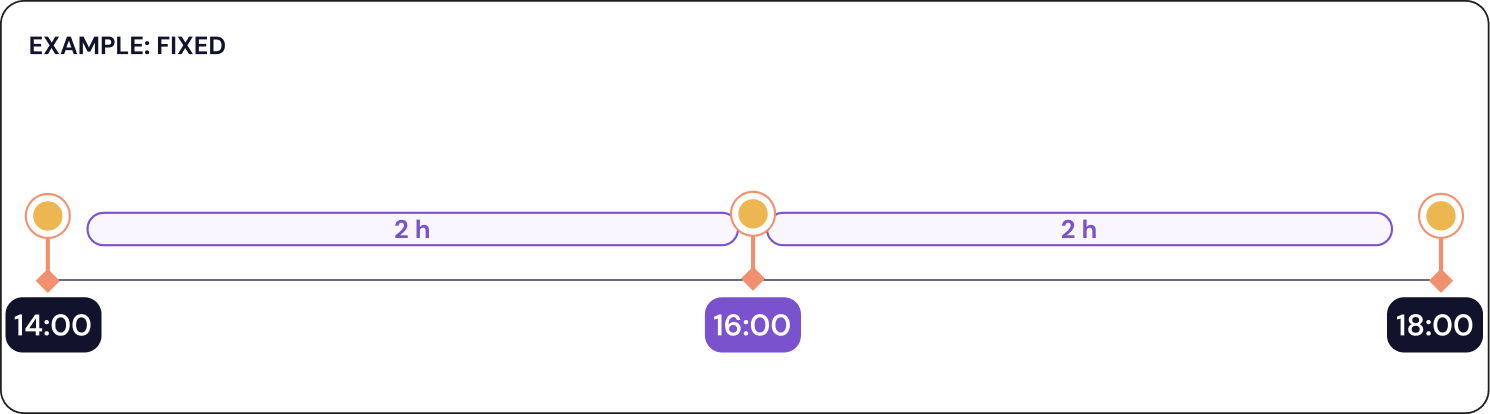
Fixed scheduling delivers tasks at specific, consistent times: a set clock time or a regular interval (e.g., every 4 hours). It's the right choice when the time of measurement is scientifically meaningful in its own right: circadian studies, medication adherence checks, sleep quality journals, or any protocol where valid longitudinal comparison requires the same temporal context across days.
When configuring a fixed schedule, you'll also set a visibility window, which controls how long the task stays available before being marked Missed. A tight window (30-60 min) keeps responses timely; too wide and you risk temporal drift in your data.
Use Case: Medication Adherence Protocol
Task: "Did you take your medication as prescribed?"
Recurrence: Daily | Schedule type: Fixed
Delivery: Every 4 hours between 9:00 AM and 9:00 PM | Visibility: 60 min
Why Fixed: Adherence must be assessed against a specific clinical schedule. Randomizing prompt timing would make it impossible to attribute responses to a defined dosing window.
Scientific impact: High construct validity for adherence measurement; enables detection of time-of-day non-adherence patterns.
What is semi-randomized EMA scheduling and when should you use It?
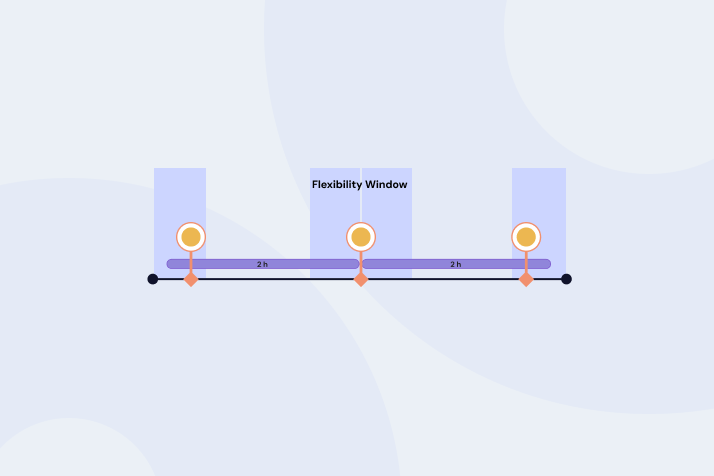
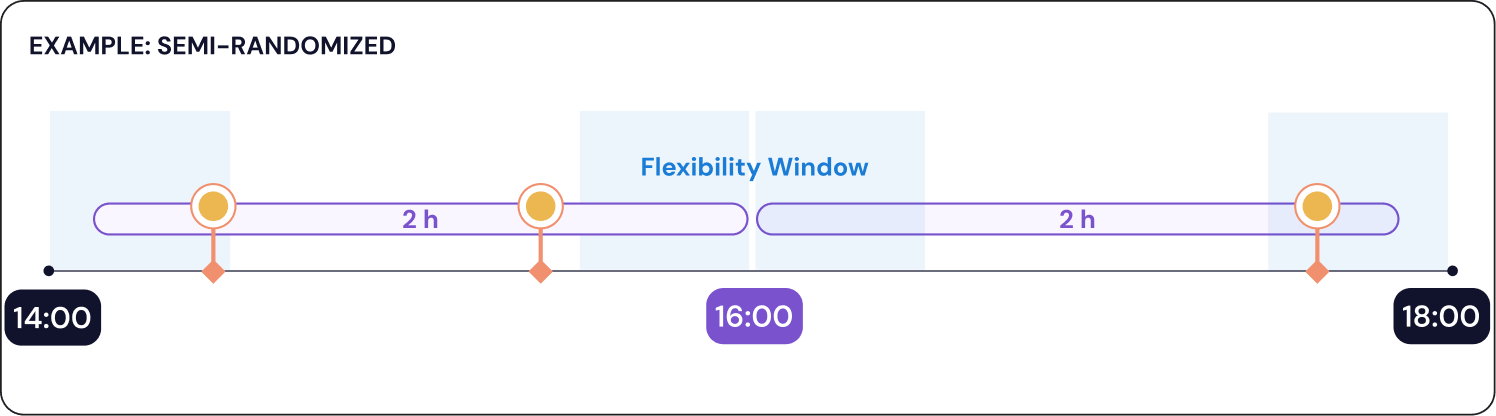
Semi-randomized scheduling fires prompts near regular intervals but with a randomized flexibility window around each one, configured as "approximately every X hours +/- Y minutes." A prompt set for 11:00 AM with a +/-1-hour window could arrive any time between 10:00 AM and 12:00 PM. Participants can't predict it; researchers still get even daily coverage.
This is the best default for most mood, stress, and behavior tracking studies. It reduces anticipatory bias while making sure morning, afternoon, and evening are all sampled. When temporal coverage and unpredictability are both priorities, semi-randomized scheduling gets the balance right.
Use Case: Fatigue Tracking in a Long COVID Study
Task: "How mentally and physically tired do you feel right now?"
Recurrence: Daily | Schedule type: Semi-randomized
Frequency: Every 4 hours ± 1 hour, from 7:00 AM to 11:30 PM | Visibility: 45 min
Why Semi-Randomized: The study needs full-day coverage to detect diurnal fatigue trajectories, but fixed timing would let participants anticipate and rehearse fatigue ratings rather than reporting spontaneous experience.
What is fully randomized EMA and why does minimum spacing matter?
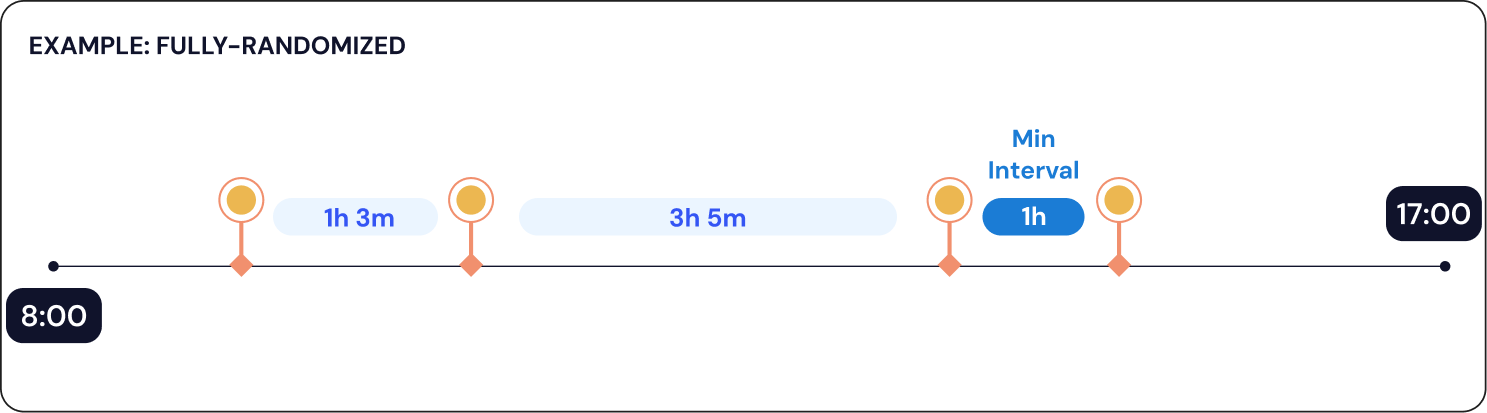
Fully randomized scheduling delivers a set number of prompts per day at genuinely random times within a waking window, with a configurable minimum spacing to prevent clustering. For example: 3 prompts between 8:00 AM and 11:00 PM, minimum 1 hour apart. Exact timing is unpredictable, so participants can't anticipate, prepare, or time-manage their responses.
This is the gold standard for capturing spontaneous psychological states: craving, impulsivity, stress reactivity, or any experience that varies moment-to-moment and would be distorted by expectation. The minimum spacing parameter matters a lot here. Without it, random delivery can occasionally fire two prompts minutes apart, creating artificial autocorrelation in your time-series data.
Use Case: Craving in a Smoking Cessation Study
Task: "Are you experiencing any cravings right now?" + contextual follow-ups
Recurrence: Daily | Schedule type: Fully randomized
Frequency: 4 prompts between 9:00 AM and 9:00 PM | Min. spacing: 90 min
Why Fully Randomized: Craving is spontaneous and unpredictable. If participants know a prompt is coming, they may suppress or manage craving states beforehand, fundamentally altering the phenomenon being studied.
Here's how all three schedule types work together in a single study on how sleep patterns and short-term medication affect daily mood in adults aged 25-40.
Full Protocol Overview
Task 1 — Onboarding Baseline Questionnaire
One-time only | Fixed | Visible: Day 1 (8:00 AM) through Day 7 (11:59 PM)
Task 2 — Stress, Mood & Energy EMA
Daily (Days 1-14 and Days 28-36) | Fully Randomized
5 prompts/day, 9:00 AM-9:00 PM | Visibility: 30 min per instance
Task 3 — Weekly Sleep Journal
Every Saturday | Fixed | Visible: 7:00 AM-7:00 PM
Task 4 — Medication Intervention Check-in
Daily (Days 8-14) | Fixed | Visible: 7:00 AM-11:00 AM
Tips for researchers
Match the schedule to the construct. Fixed for structured routines; randomized for spontaneous states.
Watch participant fatigue. 3-5 prompts/day is the practical upper limit most researchers land on for long-term compliance.
Mix schedule types. Fixed morning anchors combined with randomized daytime EMA is a common and effective approach.
Set tight visibility windows. 30-45 minutes keeps responses ecologically valid; longer windows introduce temporal drift.
Pilot before launch. Schedules can be edited after a project goes live, but with limitations. Finalize before adding participants.
Check notification settings. Participants need Labfront notifications enabled and should not fully close the app.
Ready to try advanced scheduling?
Explore the full scheduling documentation or start building your protocol in the New Project dashboard.
Fixed scheduling delivers prompts at consistent, predictable times — the same clock time or interval every day. Semi-randomized scheduling fires prompts near regular intervals but with a randomized offset (a flexibility window), so participants can't predict the exact time. Fully randomized scheduling delivers a set number of prompts at genuinely random times within a daily window, with a minimum spacing between prompts to prevent clustering. Fixed is best for protocols where timing is scientifically meaningful (e.g., medication adherence). Semi-randomized suits mood and behavior tracking that needs both even coverage and unpredictability. Fully randomized is the gold standard for capturing spontaneous states like craving or stress reactivity.
Anticipatory bias occurs when participants can predict when an EMA prompt will arrive. Knowing a survey is coming at 2:00 PM leads participants to mentally rehearse their responses in advance, reporting a prepared answer rather than their actual current state. This inflates correlations between consecutive data points and flattens within-person variability. Semi-randomized and fully randomized scheduling address anticipatory bias by making prompt timing unpredictable, so participants are always caught in a genuine moment rather than a prepared one.
Without a minimum spacing constraint, a purely random distribution will occasionally deliver two prompts very close together — sometimes within minutes. When that happens, participants are asked to re-rate a state that hasn't had time to change, producing artificially high autocorrelation in your time-series data and reducing your effective sample size. Labfront's fully randomized scheduling lets you set a minimum interval between prompts (e.g., 60 or 90 minutes) to prevent this without sacrificing genuine temporal unpredictability.
The flexibility window is the randomized time range around a scheduled prompt within which it can be delivered. For example, a prompt set for 3:00 PM with a 30-minute flexibility window will fire at a random time between 2:30 PM and 3:30 PM. The exact time within that window is genuinely random, so participants cannot anticipate it. The flexibility window balances two needs: even daily coverage (from the regular base interval) and unpredictability (from the randomized offset).
Yes. Labfront lets you assign multiple schedules to tasks within the same project, and different tasks can use different schedule types. A common design is a fixed morning baseline check-in combined with fully randomized daytime EMA prompts. You can also combine one-time tasks (like an onboarding questionnaire) with recurring tasks running on different patterns across different study phases.
No. Advanced task scheduling is only available in new projects created after October 2025. Legacy projects use a different system and cannot be updated to use this feature. If you have an upcoming study, you will need to create a new project to access fixed, semi-randomized, and fully randomized scheduling options.
Ready to try advanced scheduling?
Explore the full scheduling documentation or start building your protocol in the New Project dashboard.
All-In-One Research Solution for Real-World Data Capture
Labfront is a health data analytics company that offers a comprehensive product designed to help researchers collect, analyze, and derive insights from wearable device data. Their platform integrates seamlessly with various health sensors, providing advanced analytics and customizable features to support scientific research in fields such as sleep, stress, and overall physiological monitoring.
Subscribe to Human Science
Subscribe to Human Science
“Now, more than ever, we need tools like Labfront that can help researchers take their research and data collection virtual.”
Dr. Gloria Yeh, MD
Associate Professor of Medicine, Harvard Medical School
“The Labfront team was extremely responsive to our requests and made every effort to accommodate our unique needs.”
Yogev Kivity, Ph.D.
Senior Lecturer of Psychology, Bar Ilan University
"Labfront's analysts understood our needs as researchers and saved us weeks of work when they prepared our datasets for analysis."
Bryan Edwards, Professor, Joe Synar Chair
Management Department, Oklahoma State University
“The physiological data really helped provide deeper insights. We recommend Labfront and will definitely be using it again!”





.svg)


.webp)


.svg)