



Diabetes prevention and management depend on data that clinical visits can't reliably capture. Continuous physiological signals like steps, sleep, heart rate, and related lifestyle patterns collected in the real world, over time, from the populations most affected. That's what wearables make possible, and it's the research this grant was built around.
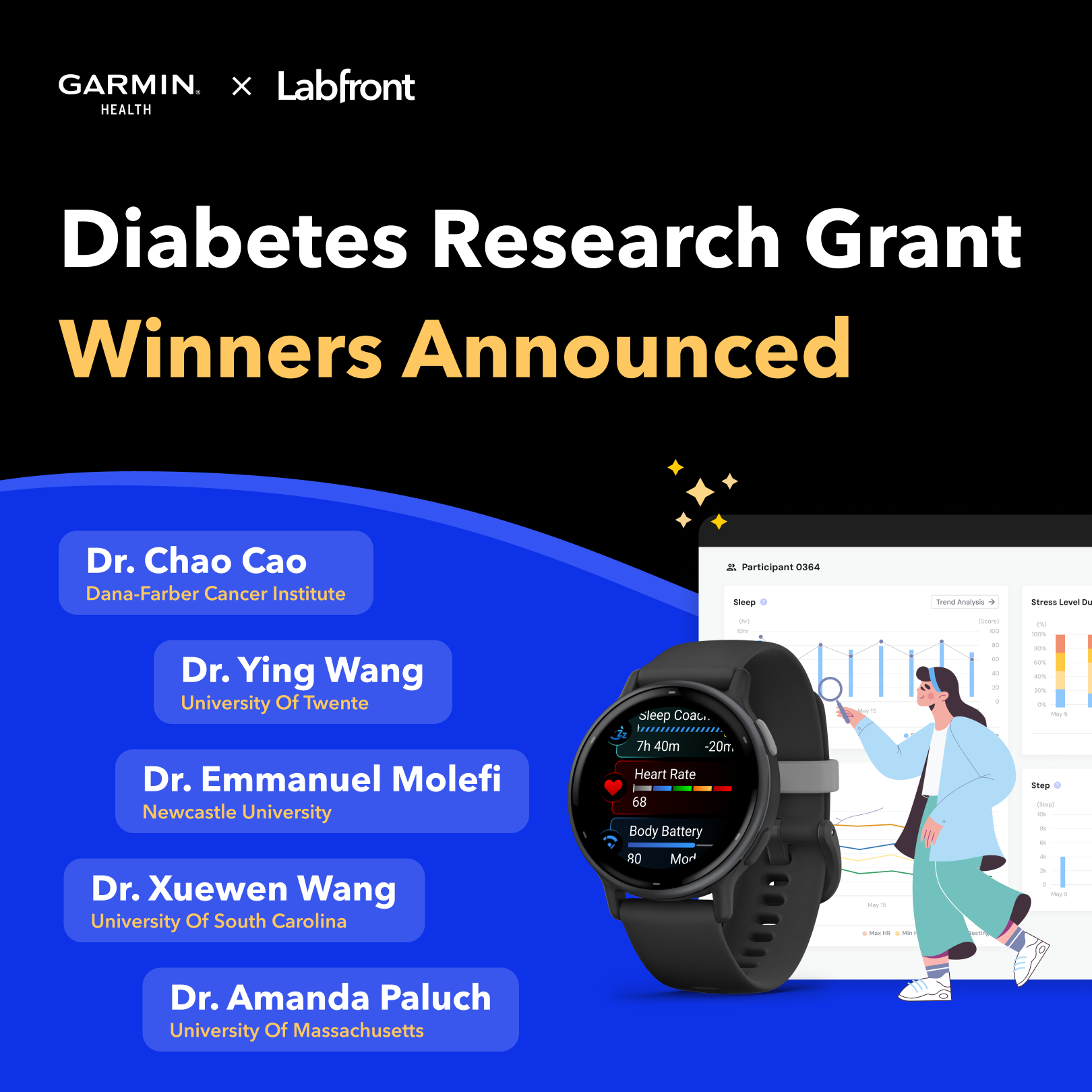
The Garmin Health and Labfront Diabetes Research Grant supports investigators across the Americas and EMEA who use Garmin wearable data to support research related to diabetes risk and population health. This cycle drew applications from teams across countries and career stages. Five were selected.
Their work spans sleep extension, walking prescription, cardiac autonomic neuropathy, metabolic health in cancer survivors, and chronobiological rhythms in underrepresented populations. Each team receives 5 Garmin vívoactive 5 devices1 and full access to the Labfront platform for one year.
Chao Cao, Dana-Farber Cancer Institute, United States
Wearable digital biomarkers for to explore patterns related to metabolic health in cancer survivors
Cancer survivors face elevated cardiometabolic risk, and routine clinical care has no scalable way to track the physiological changes that precede it. Cao, an Instructor at DFCI and Harvard Medical School, is building toward that through the Healthy Living Program at DFCI, a structured lifestyle counseling and exercise program that gives him a real-world setting to work in.
Cao's team will collect continuous data on steps, activity intensity, heart rate, sleep, and stress via Garmin and Labfront, then integrate those measures with clinical metabolic markers. The goal is to identify patterns observed in wearable data and investigate how these relate to metabolic health trends in research settings, with the aim of generating insights for future study. He's been developing this direction through his work on the Breast Cancer Weight Loss (BWEL) Trial. This project is the next step.
"Through my work with clinical and lifestyle intervention programs, including the Healthy Living Program at DFCI, I have seen firsthand the need for better tools to monitor health behaviors and identify early signals of metabolic risk."
Xuewen Wang, University of South Carolina, United States
Feasibility of sleep extension for reducing diabetes risk
Wang's group has already shown what sleep loss does: insulin sensitivity dropped after just 3 days of cutting sleep by an average of 1.5 hours per day. Cutting sleep by an average of 24 minutes per day over 8 weeks worsened glucose metabolism and weight loss outcomes in a dietary restriction program. The next question is whether the relationship runs the other way.
This pilot enrolls 10 adults sleeping under 6.5 hours per night who meet 2 or more diabetes risk criteria. Participants wear Garmin devices with data collected via Labfront for research purposes through a 6-month behavioral intervention targeting sleep above 7 hours per night. Diabetes risk is assessed via oral glucose tolerance test with vascular health assessment.
Current behavioral diabetes prevention programs say nothing specific about sleep. If this pilot shows that extending sleep in short sleepers reduces T2DM risk, that changes.
Emmanuel Molefi, Newcastle University, United Kingdom
Chronobiological dynamics of type 2 diabetes in minority ethnic groups
People from Black African, Black Caribbean, and South Asian communities have higher T2D prevalence and earlier onset. They're also underrepresented in the datasets used to train the monitoring tools and predictive algorithms most clinicians rely on. Those two facts are related.
Molefi leads the Wellcome Trust-funded Diversity in Chronobiology study, a healthy-participant cohort running across Botswana, Brazil, Indonesia, Singapore, and the UK. This project applies that framework to a clinical T2D population for the first time. 20 individuals with T2D from UK minority ethnic communities wear Garmin devices for 2 weeks. Labfront integrates the continuous wearable data with CGM and self-reported behavioral measures including mood, sleep, exercise, and mealtimes.
Three aims: build a curated multimodal dataset of biological rhythms in underrepresented populations; test whether machine learning can extract low-dimensional latent rhythms from that data; and investigate associations between wearable-derived heart rate phase and glucose regulation. The output, if it works, is an evidence base for personalized, passive detection of diabetes complications in populations that current algorithms largely ignore.
Ying Wang, University of Twente, the Netherlands
Real-world wearable extension of a type 1 diabetes autonomic neuropathy study
Cardiac autonomic neuropathy is an early T1D complication that often goes undetected until it causes real physiological strain. Wang, Assistant Professor in Biomedical Signals and Systems at the University of Twente, is already running an ethics-approved autonomic neuropathy study with local hospital ZGT, combining CGM data with cardiovascular autonomic reflex testing. This project adds what that study currently can't capture: what happens at home.
After the clinic visit, participants wear Garmin devices in daily life. Labfront handles remote onboarding, device synchronization, adherence tracking, and data export. The question is whether free-living HRV, sleep, activity, and recovery patterns reveal something about physiological baseline and deviation that a controlled lab visit misses. If so, this points to a need for earlier and more extensive research observation and data collection for T1D autonomic complications outside the clinic.
Amanda Paluch, University of Massachusetts Amherst, United States
Steps vs. speed: a wearable-enabled pilot trial to optimize walking prescriptions for diabetes prevention
Should clinicians tell patients to just get their steps in, or pick up the pace? Observational research can't separate the two because step volume and pace are correlated. No RCT has held step volume constant and isolated the effect of pace on diabetes-relevant outcomes. Paluch is running that trial.
She leads the Steps for Health Collaborative, the largest harmonized consortia on daily steps and cardiometabolic health, with data from 120,000 adults. Her prior work challenged the 10,000-step norm and found adults taking 7,000-8,000 steps per day have a 30-50% lower risk of cardiovascular disease, diabetes, and mortality compared to those taking 4,000-5,000.
24 low-active adults (65+) averaging under 4,000 steps per day are randomized to one of 3 arms, each prescribed an identical +3,000 steps per day over 12 weeks: slow pace, self-selected pace, or brisk pace calibrated from a 6-minute walk test. 5 Garmin vívoactive 5 devices and Labfront Advanced provide continuous cadence, heart rate, and step data throughout, with real-time coaching review and weekly pace adjustment. Primary outcomes: fasting glucose and HbA1c.
What comes next
We're excited to share results as they emerge. Applications for future grant cycles open at labfront.com/grant.
¹Garmin smartwatches are not designed or intended to monitor or diagnose diseases or any medical conditions. Find information on metric accuracy here.

Labfront is a health data analytics company that offers a comprehensive product designed to help researchers collect, analyze, and derive insights from wearable device data. Their platform integrates seamlessly with various health sensors, providing advanced analytics and customizable features to support scientific research in fields such as sleep, stress, and overall physiological monitoring.


.svg)


.webp)


.svg)